01Executive Summary
Türkiye's external debt history begins with a £3 million loan raised in London in 1854 to finance the Crimean War and closes its first, hundred-year cycle on 25 May 1954, when the Republic paid the final instalment of the Ottoman debt. The central finding of this report is that a second and larger cycle opened as soon as the first closed: the legacy debt zeroed in 1954 had become $16 bn by 1980, $130 bn by 2002 and $539 bn of gross external debt by mid-2026.
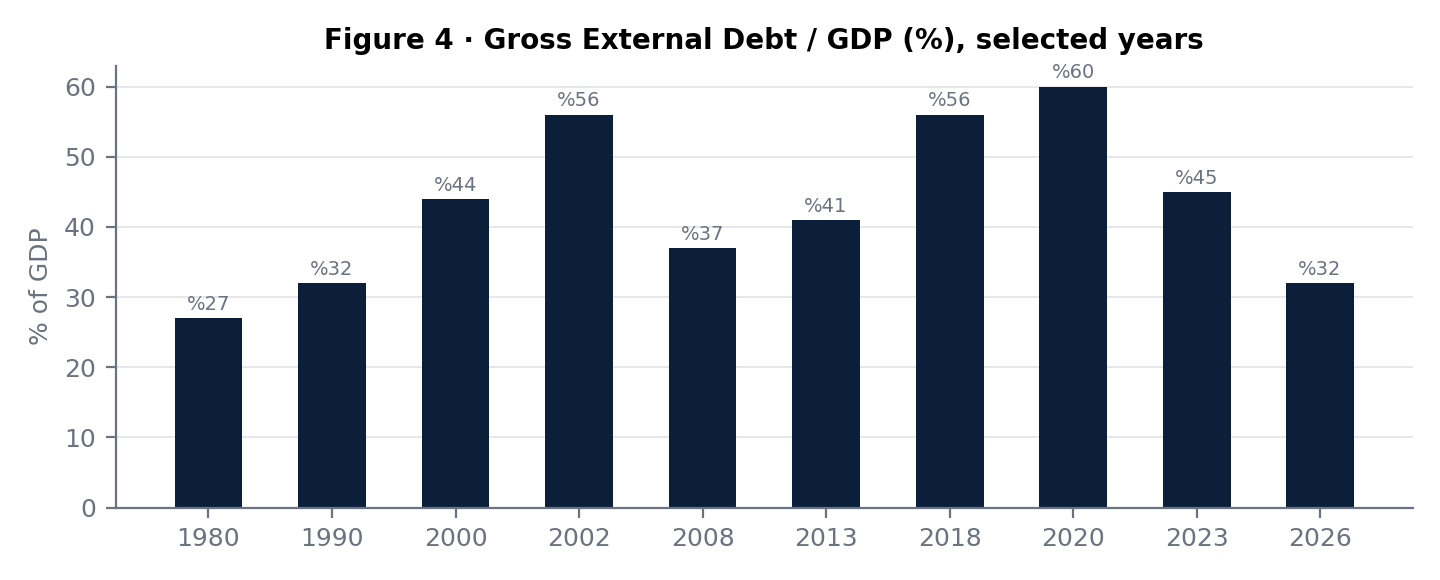
The size of the stock is misleading on its own. At 31.8% of GDP, external debt is well below the emerging-market average and public debt is around 23% of GDP. Türkiye faces not a "debt crisis" but a cost-of-interest and roll-over-dependency problem:
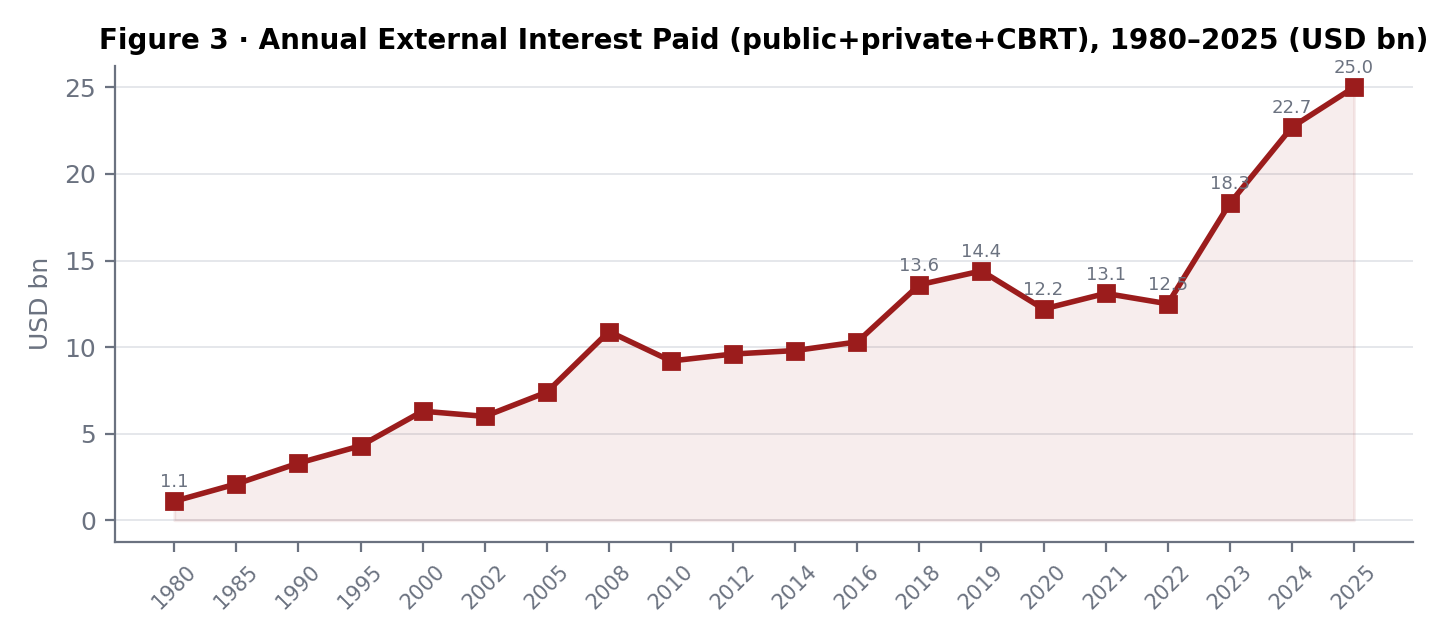
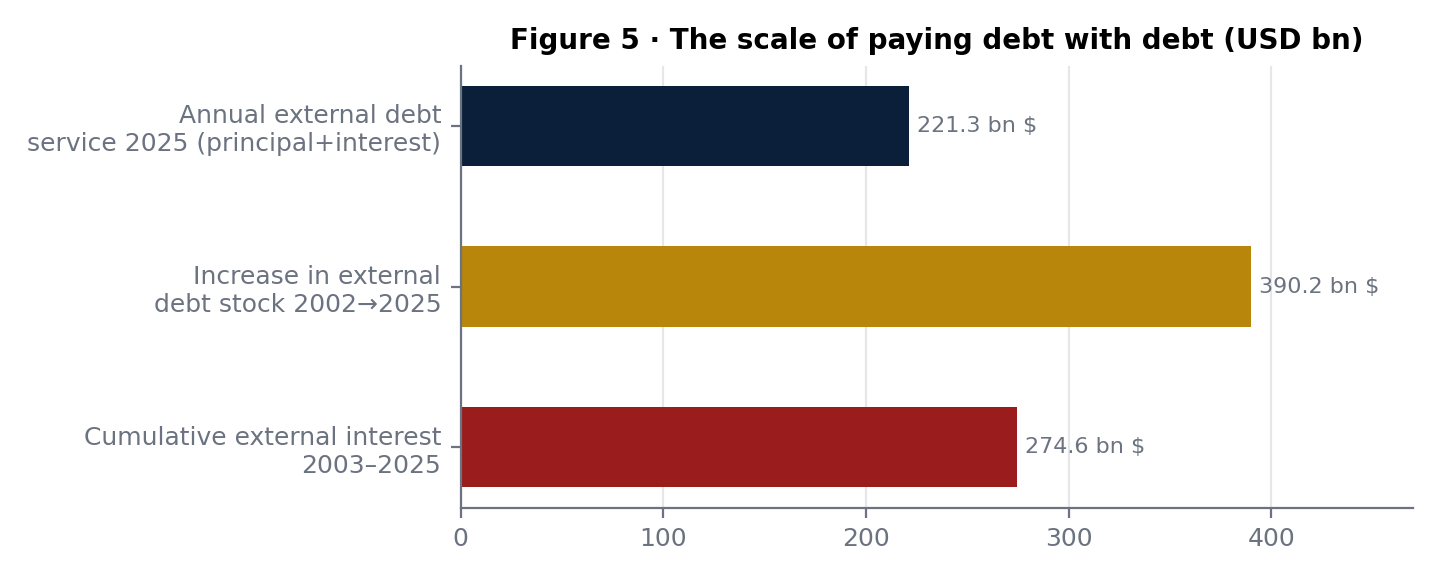
- External interest paid in 2025 ($25 bn) is more than four times the 2002 figure ($6 bn); the stock grew 4.3× — interest has grown faster than debt.
- Cumulative external interest 2003–2025 ($274.6 bn) exceeds twice the entire 2002 stock ($130 bn): Türkiye paid its 2002 debt twice over in interest, and the stock grew.
- External liabilities falling due in 2025 totalled $221 bn; with the current account deficit, annual refinancing needs exceed $250 bn — roughly 17% of GDP rolled over every year.
- Public external debt is $197.9 bn (37% of the stock); the cost has largely migrated to the private sector ($16.6 bn of 2025 external interest).
02Ottoman Borrowing: From the First Loan to Moratorium (1854–1881)
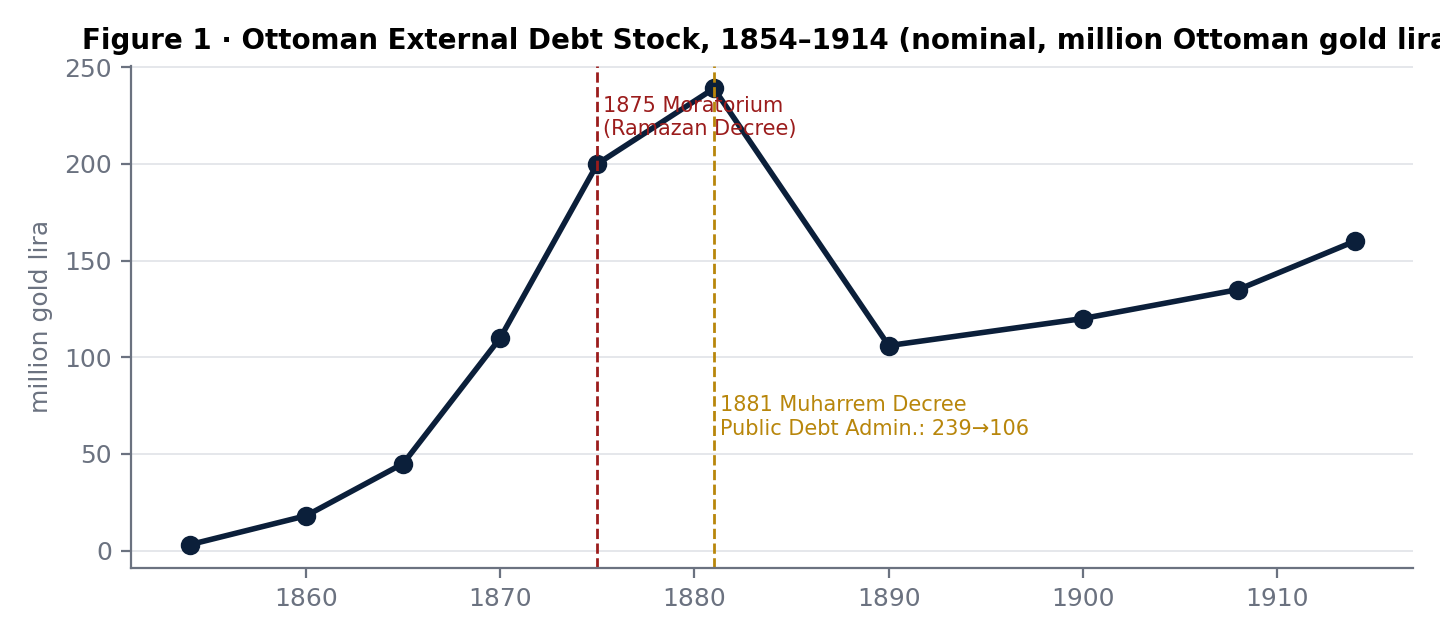
The Ottoman state avoided foreign borrowing until the Crimean War. The first bond (24 August 1854, Palmer & Co./Goldschmidt) — £3 m, 6% coupon, issued at 80, secured on the Egyptian tribute — set the pattern of the next twenty years: nominal 3, received 2.3, interest on the nominal. Between 1854 and 1874 about £212 m nominal was raised at an average issue price near 60; only ≈ £116 m reached the Treasury. The effective cost of a 6% coupon on money actually received was 10–12%. By 1874 debt service (≈ £14 m) absorbed 55–60% of revenue (≈ £22–25 m), and the 1874 loan was explicitly raised to pay interest.
| Year | Loan | Nominal £m | Issue price | Net £m | Coupon | Security / purpose |
|---|---|---|---|---|---|---|
| 1854 | Palmer–Goldschmidt | 3.0 | 80 | 2.3 | 6% | Egyptian tribute; Crimean War |
| 1855 | Rothschild (Anglo-French guarantee) | 5.0 | 102.6 | 5.1 | 4% | Tribute + Smyrna/Syria customs |
| 1858 | Dent, Palmer | 5.0 | 76 | 3.8 | 6% | Istanbul customs; paper-money retirement |
| 1862–63 | Imperial Ottoman Bank (2) | 16.0 | 68–71 | 11.1 | 6% | Tobacco, salt, stamp duties |
| 1865 | General Debt + IOB | 42.4 | 50–66 | 22.2 | 5–6% | Domestic debt consolidation; deficit |
| 1869–70 | Comptoir d'Escompte; Rumelia Railways (Hirsch) | 53.9 | 32–54 | 22.2 | 3–6% | Deficit; railway lottery bonds |
| 1871–73 | IOB; Treasury bill consolidation; Crédit Mobilier | 44.6 | 54–98.5 | 30.1 | 6–9% | Short-term roll-over; deficit |
| 1874 | General Debt | 40.0 | 43.5 | 17.4 | 5% | Borrowing to pay interest |
| Total 1854–1874 (≈) | ≈ 212 | avg ≈ 60 | ≈ 116 | avg 5.6% | 45% of nominal lost on paper | |
6 October 1875 (Ramazan Decree): half of debt service to be paid in new 5% bonds; within a year cash payments stopped too — de facto default in 1876. The moratorium was not unwillingness to pay but arithmetic: once debt service exceeds 50% of revenue, paying interest with new debt grows the stock 8–10% a year, and each 100 units of interest creates 160–180 units of new nominal debt because of issue discounts.
03The Public Debt Administration (1881–1923): The Cost of Lost Fiscal Sovereignty
The Muharrem Decree (20 December 1881) consolidated 239 m gold lira of nominal debt plus 53 m of arrears into 106.4 m lira at 1–4% interest — a haircut above 55%. In exchange the Ottoman Public Debt Administration was created and the salt and tobacco monopolies, silk tithe, fishing, stamp and spirits duties, the Eastern Rumelia tribute and Cyprus surplus were assigned to it. By 1912 the Administration employed over 5,000 staff — larger than the Finance Ministry — and directly managed silk, salt and tobacco production.
| Item | m gold lira | Note |
|---|---|---|
| Pre-1881 nominal debt | 239.0 | 1854–74 loans + 1875 bonds |
| Accrued unpaid interest | 53.0 | 1875–81 |
| Consolidated debt, Muharrem Decree | 106.4 | > 55% haircut |
| Revenues assigned to the Administration, 1882 / 1912 | ≈ 2.5 / 3.5 per yr | 20–30% of state revenue |
| Collected by the Administration 1882–1914 | ≈ 95 | Interest + amortisation + costs |
| New borrowing 1886–1914 (guaranteed by the Administration) | ≈ 160 | Baghdad Railway, Hejaz, navy, 1908–14 deficits |
| External debt stock 1914 | ≈ 160 | New loans exceeded the consolidated old debt |
04From Lausanne to the Last Instalment (1923–1954): The Only Net-Reduction Period
At Lausanne (24 July 1923, Articles 46–57) the Turkish delegation secured apportionment of the Ottoman debt among successor states on a revenue basis: Türkiye assumed 62% of pre-1912 and 67% of post-1912 debt — ≈ 84.6 m gold lira of principal, ≈ 107 m with interest — while Greece, Syria-Lebanon, Iraq, Palestine, Bulgaria, Yugoslavia and others took the remainder (≈ 130 m in total).
| Period | Regime | Annual (≈) | Period total (≈) | Note |
|---|---|---|---|---|
| 1923–28 | Negotiation — no payments | — | — | Interest accrual disputed |
| 1929–30 | 1928 Paris Agreement, gold lira | 2.0 m gold lira | 3.5 m | Suspended 1930 after the gold standard collapsed |
| 1933–39 | 1933 Paris Agreement, French francs (962 m FF; maturity 1952) | 45 m FF | 300 m FF | 1936 and 1938 franc devaluations cut the real burden |
| 1940–44 | War; partial payment | varies | 150 m FF | Balance reduced to 8 m TL in 1944 |
| 1945–54 | Turkish lira instalments | 0.8 m TL | 8 m TL | 25 May 1954: final instalment |
05The Republic's Own Borrowing: Stock and Interest by Year (1950–2026)
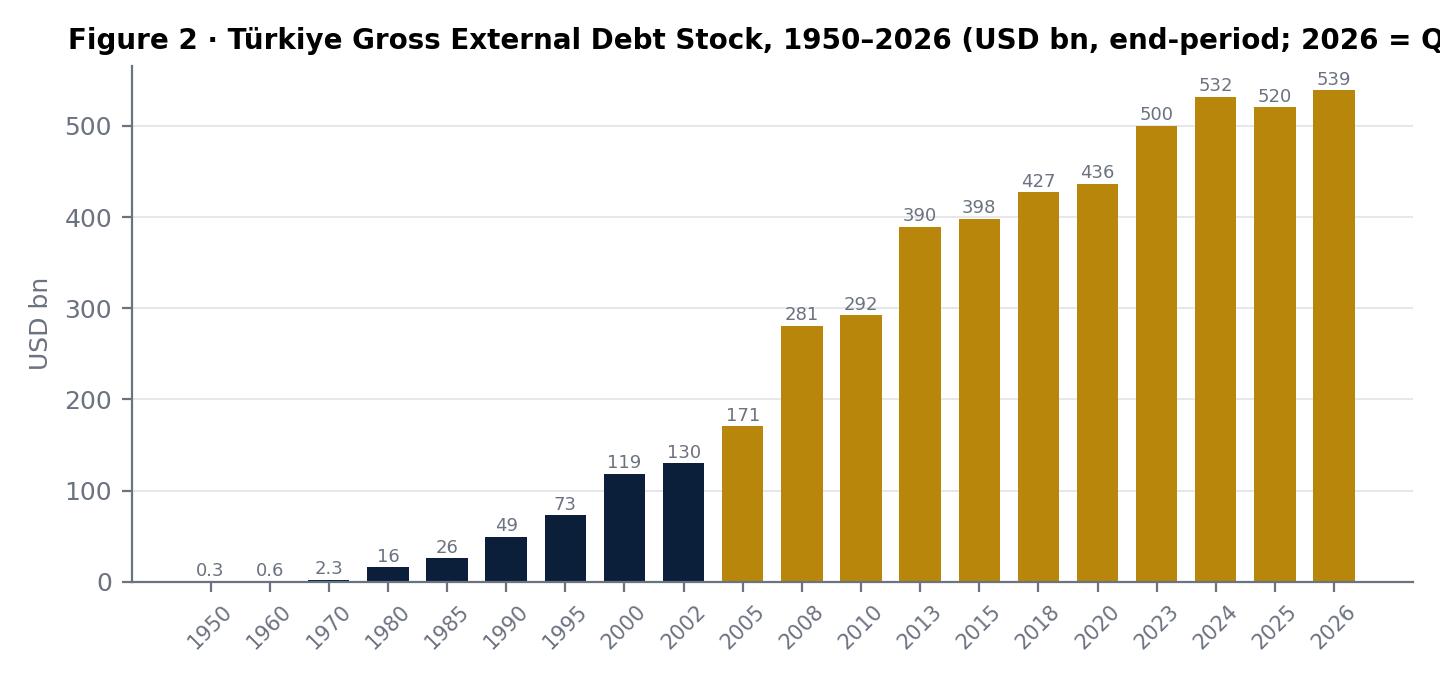
| Year | Gross external debt $bn | Public share | External interest $bn | Debt/GDP | Event |
|---|---|---|---|---|---|
| 1958 | 0.90 | ≈95% | 0.03 | ≈10% | First rescheduling; 69% devaluation |
| 1970 | 2.3 | ≈90% | 0.08 | ≈13% | Devaluation; convertible FX deposits begin |
| 1978 | 14.9 | ≈70% | 0.7 | ≈22% | Payment difficulties; second rescheduling |
| 1980 | 16.2 | ≈75% | 1.1 | 27% | 24 January decisions; 33% devaluation |
| 1990 | 49.4 | ≈70% | 3.3 | 32% | Capital account liberalised (1989) |
| 1994 | 65.6 | ≈65% | 3.9 | 50% | April crisis; short-term outflows |
| 2001 | 113.6 | ≈55% | 7.1 | 58% | February crisis; IMF 19th Stand-by |
| 2002 | 130.3 | ≈55% | 6.0 | 56% | Transition to a Strong Economy programme |
| 2008 | 281.1 | 28% | 10.9 | 37% | Global crisis |
| 2013 | 389.5 | 30% | 9.7 | 41% | Investment grade (briefly) |
| 2018 | 427.2 | 33% | 13.6 | 56% | Currency shock |
| 2020 | 436.3 | 39% | 12.2 | 60% | Pandemic; reserve erosion |
| 2023 | 499.9 | 41% | 18.3 | 45% | Return to orthodox policy |
| 2025 | ≈520.5 | ≈38% | 25.0 | ≈35% | Record external interest |
| 2026 Q2 | 539.0 | 37% | — | 31.8% (est.) | Short-term 170.7; long-term 368.2; 49% USD, 29% EUR, 12% TL |
Three reschedulings, three lessons. 1958: external debt cannot grow faster than export capacity. 1978–80: private FX debt taken through banks became Treasury debt when the exchange rate was held — the most important warning for today's $318 bn of private external debt. 2001: when interest exceeds tax revenue (103% in 2001) the market closes the cycle by force.
06The Arithmetic of Paying Debt with Debt
| Parameter | 1854–74 Ottoman | 1990–2001 | 2018–23 | 2024–26 |
|---|---|---|---|---|
| Effective borrowing cost (r) | 10–12% (gold) | 8–10% ($) / 90%+ (TL) | 5–7% ($) | 6–8% ($) |
| Income growth (g, same currency) | 2–3% | 3–4% | 0–2% | 8–12% (real appreciation) |
| r – g | +8–9 pts | +5 pts | +4–5 pts | –2 to –4 pts |
| Interest / government revenue | 55–60% | 77–103% | 9–11% | 11–15% |
| Average maturity | Shortening | Shortening | Shortening (34% short) | Flat (32%) |
| Outcome | 1875 moratorium | 2001 crisis + IMF | 2021–23 currency shock | Fragile stability |
Opportunity cost. The $66 bn of external interest paid in 2023–2025 is more than twice the net FDI received in the same three years (≈ $30 bn): the country pays more to retain capital than it attracts. Maturity is the silent signal. Every historical break was preceded by shortening maturities about three years earlier. With ≈ $220 bn due within twelve months against gross reserves of ≈ $180 bn (net far lower), roll-over capacity depends entirely on uninterrupted market access — exactly what closed in 1875 and 2001.
07Strategic Options and the Role of the Türkiye Wealth Fund
| Lever | Mechanism | Precedent | Scale | Risk |
|---|---|---|---|---|
| 1. Lower the risk premium | BB+ → BBB− cuts new-issue margins 150–250 bp | Türkiye 2005–12; 2013 investment grade | $3–5 bn/yr on $221 bn rolled annually | Gains evaporate on programme slippage |
| 2. Extend maturity, manage currency | Short-term share 32% → 25%; TL share of external debt 12% → 20% | Treasury 2004–07 extension | Cuts 12-month due amount by $40–50 bn | Longer tenor costs more up front |
| 3. Reduce debt from the asset side (TVF) | Partial IPOs / strategic stakes in low-yield TVF assets; proceeds to Eurobond buybacks | Temasek, Khazanah debt-asset swaps | Each $10 bn retired ≈ $0.6–0.8 bn/yr saved | Pricing; perception; strategic control |
| 4. Primary surplus and current account | Current deficit below 1% of GDP cuts financing need $30–35 bn/yr | 2001–04 6.5% primary-surplus programme | Breaks roll-over dependency structurally | Growth and political cost |
Specific recommendations for TVF
- Debt-for-asset swap programme: gradual monetisation of TVF assets yielding below the sovereign cost, proceeds to Eurobond buybacks; 20–25% of the $8.4 bn public+CBRT external interest could be eliminated within five years.
- Consolidated public balance sheet: report TVF assets and Treasury external debt as one net public position so agencies rate net rather than gross debt — the cheapest path to an upgrade.
- Contingent-liability monitoring: joint TVF/Treasury stress test of the $318 bn private external debt, pricing the segment likely to be nationalised in a currency shock (energy and infrastructure PPPs with guaranteed FX revenues).
- Domestic savings channel: long-dated TL bonds issued by TVF subsidiaries to raise the TL share of external debt, lengthen maturities and cut currency risk.
Sources
CBRT External Debt Statistics Q1–Q2 2026 and remaining-maturity short-term debt; Ministry of Treasury and Finance Public Debt Management Reports and Financing Programmes; World Bank International Debt Statistics (DT.DOD.DECT.CD, DT.INT.DECT.CD); Blaisdell, European Financial Control in the Ottoman Empire (1929); Kıray (1993); Pamuk (2007, 2014); Clay, Gold for the Sultan (2000); Birdal (2010); Treaty of Lausanne Part II; 1928 and 1933 Paris Agreements. Pre-1980 interest figures are estimates; 2024–25 year-end stocks are derived from CBRT quarterly revisions and marked "≈".